
News
Why AI May Have a Bigger Impact on Embedded Verification Than Embedded Development
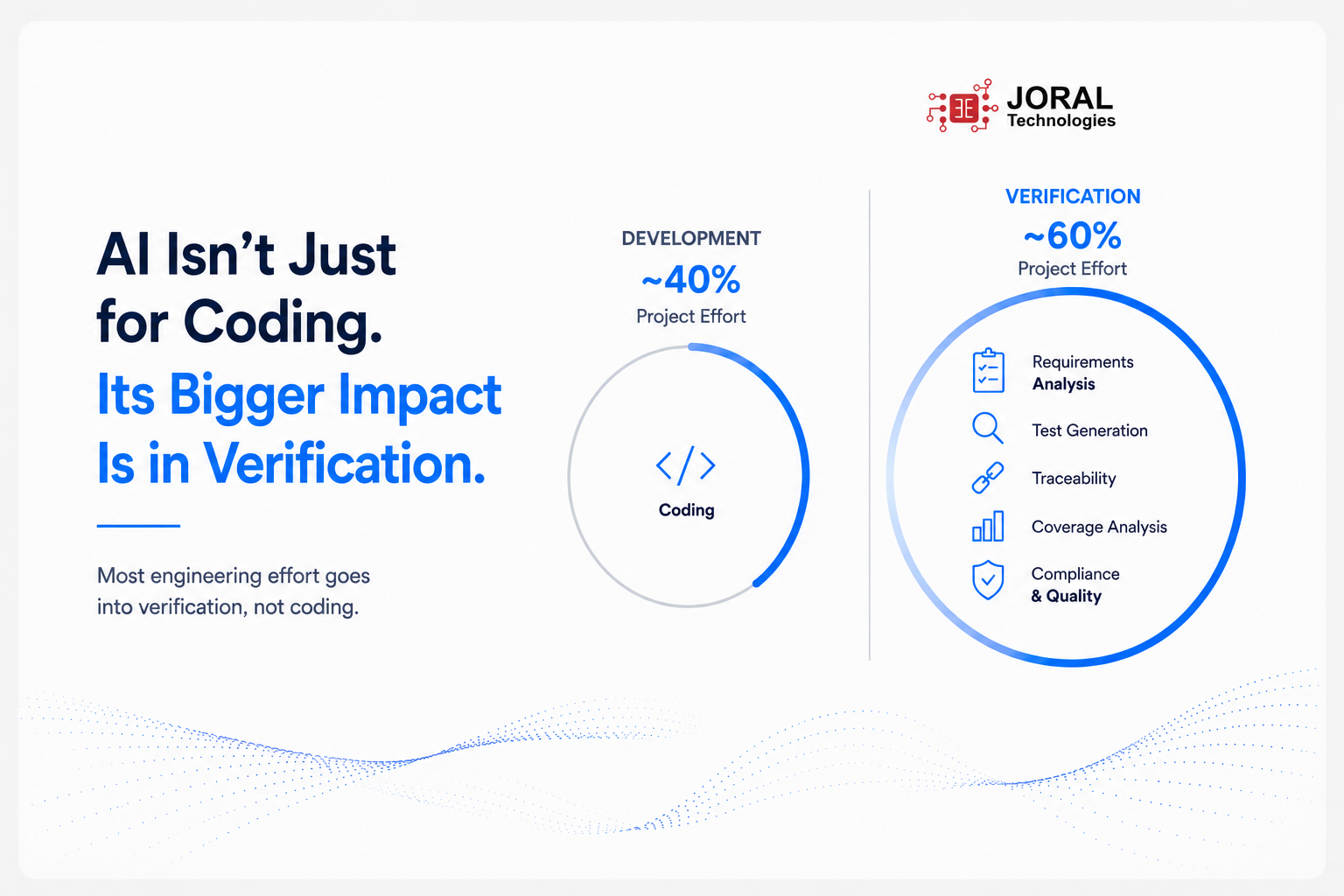
Much of the discussion surrounding AI in embedded systems has focused on one question: Can AI write embedded software? While AI assisted code generation continues to evolve, many engineering organizations are discovering that AI's greatest opportunity may lie elsewhere in reducing the growing effort associated with software verification. In modern embedded projects, activities such as requirements analysis, test development, traceability management, coverage analysis, and compliance verification can consume 50–70% of the overall software development effort. As products become more complex and schedules become tighter, improving verification efficiency has become just as important as accelerating software development. Rather than replacing embedded engineers, AI is helping teams automate repetitive tasks so they can spend more time solving engineering problems. One of the earliest opportunities for AI is during requirements analysis. Large embedded projects often contain hundreds or even thousands of requirements that must be reviewed for ambiguity, consistency, completeness, and traceability. Instead of starting with a manual review, teams can use Developair to automatically identify ambiguous wording, inconsistent terminology, missing acceptance criteria, and traceability gaps. Engineers remain in control, while AI provides a valuable first pass that allows reviews to focus on engineering decisions rather than document cleanup. Verification effort continues to increase once software reaches testing. Creating and maintaining unit tests, measuring coverage, and updating regression suites after requirement changes can quickly become one of the most time consuming phases of development. AI can help generate an initial set of test scenarios directly from the requirements, which can then be imported into Cantata for execution, refinement, and automated regression testing. Instead of starting from scratch, teams begin with a solid baseline that can be expanded and validated using statement, branch, and MC/DC coverage. Depending on project complexity and process maturity, automating parts of this workflow can reduce verification effort by 20–40% while improving consistency across the test suite. AI generated code and tests still require engineering validation. Rather than replacing established verification practices, AI is becoming another tool within the embedded workflow helping engineers improve traceability, reduce repetitive effort, and deliver higher-quality software with greater confidence. Interested in modernizing your embedded software verification workflow? Contact Hrutik Champaneri at hrutik.champaneri@joraltechnologies.com to learn more and reserve your spot for our upcoming DevelopAIR and Cantata webinar. Watch the video below to explore the AI features available in Cantata and the tasks you can accomplish using Claude AI.
Learn more
AI-Powered Verification for Embedded Software: Reducing Testing Effort by 50%
For many embedded software teams, writing code is no longer the biggest challenge. Verification, validation, traceability, compliance, and maintaining test cases often consume more engineering effort than development itself. As systems become more complex and standards such as ISO 26262, DO-178C, IEC 61508, and EN 50128 grow increasingly demanding, verification activities can account for up to 50% of overall development effort in safety-critical projects. This is where Developair takes a different approach. Using AI-assisted verification and validation, Developair helps teams standardize requirements, address gaps, establish traceability, and automatically generate test artifacts. By reducing repetitive manual tasks, engineering teams can improve coverage, maintain consistency, and spend less time managing tests and documentation. Working directly from requirements and specifications, Developair connects requirements, test cases, and verification activities into a streamlined workflow. This helps reduce the risk of missed coverage, simplifies compliance efforts, and accelerates development cycles. For organizations looking to improve software quality while reducing verification costs, AI-assisted validation provides a practical and scalable path forward. As embedded systems continue to evolve, verification is becoming one of the largest bottlenecks in software development. Tools from Developair are helping organizations modernize this process by bringing automation, intelligence, and scalability to activities that have traditionally required extensive manual effort. Interested in learning how Developair can support your verification and validation workflow? Know More About Developair Solutions Learn more about Developair and how AI-powered verification and validation can support your development process. To learn more, contact hrutik.champaneri@joraltechnologies.com. Check Out a Demo Video of the Tool Below
Learn more
EMBEDDED IS EVERYWHERE
PRODUCTS
Manufacturers
Resource center