
ARM KEIL MDK Version 6 | UBL is available now!
Arm announces Keil MDK Version 6
The Keil Microcontroller Development Kit (Keil MDK) is the most comprehensive software development solution for Arm Cortex-M-based embedded, IoT, and ML edge device applications. With support for over 10,000 different microcontrollers from 38 different silicon vendors available today it is an critical part for many software projects.
Today, the demand for more machine learning (ML) capabilities in IoT applications is growing exponentially, and our roadmap has evolved to meet these needs with the introduction of the Cortex-M55 and Cortex-M85 microcontrollers (MCUs), designed to address high-performance ML and DSP workloads. As IoT devices get smarter, developers are facing increasing software complexity that requires new development flows.
To address these requirements, Arm announces Keil MDK Version 6, optimized for the entire Arm Cortex-M and Ethos-U processor portfolio.
Keil MDK Version 6 includes:
Keil Studio Desktop, an extension pack for Microsoft Visual Studio Code (VS Code) provides an integrated development environment (IDE) for Cortex-M-based microcontrollers. With full support of CMSIS workflows and an integrated debugger, it includes components to create, build, and test embedded applications.
A CMSIS-based development flow with the CMSIS-Toolbox is a critical element of Keil MDK Version 6. Starting with a device or board selection that configures the complete toolchain including debug, it gives access to reusable software components including various RTOS kernels, device drivers, and middleware.
Enhanced integration of Arm Virtual Hardware (AVH) removes the need to develop on physical silicon and enables test automation of software workloads with precise Cortex-M simulation models. Combining desktop and cloud-based workflows allows developers to embrace CI/CD, DevOps, and MLOps core concepts and a software first development approach.
Along with newly introduced host support for Windows, Linux, and macOS, MDK Version 6 continues to include the proven µVision IDE for Windows and features for functional safety. Embedded systems frequently require several years of product longevity and MDK supports the entire product lifecycle from initiation to completion and maintenance. Keil Studio Cloud continues to complement the MDK desktop tools with a ready-to-use cloud-native development environment that requires no installation.
RELATED NEWS

Percepio Detect: Catching Embedded Software Issues Before They Become Failures
Embedded applications can pass unit tests, perform reliably in the lab, and still encounter unexpected failures after hours of operation. Occasional timing problems, stalled RTOS tasks, and inter[...]
Read more
CompCert: A C Compiler That Comes With a Proof
Safety-critical teams put considerable effort into their C source code. They run static analysis, check MISRA rules, review code, and test the compiled software extensively. However, testing cann[...]
Read more
New target aiT for TriCore now supports 3rd GEN AURIX TC46x. Qualification Support Kits Qualification reports can now be exported as XML. New compiler-specific QSKs: aiT for e200 with Diab [...]
Read more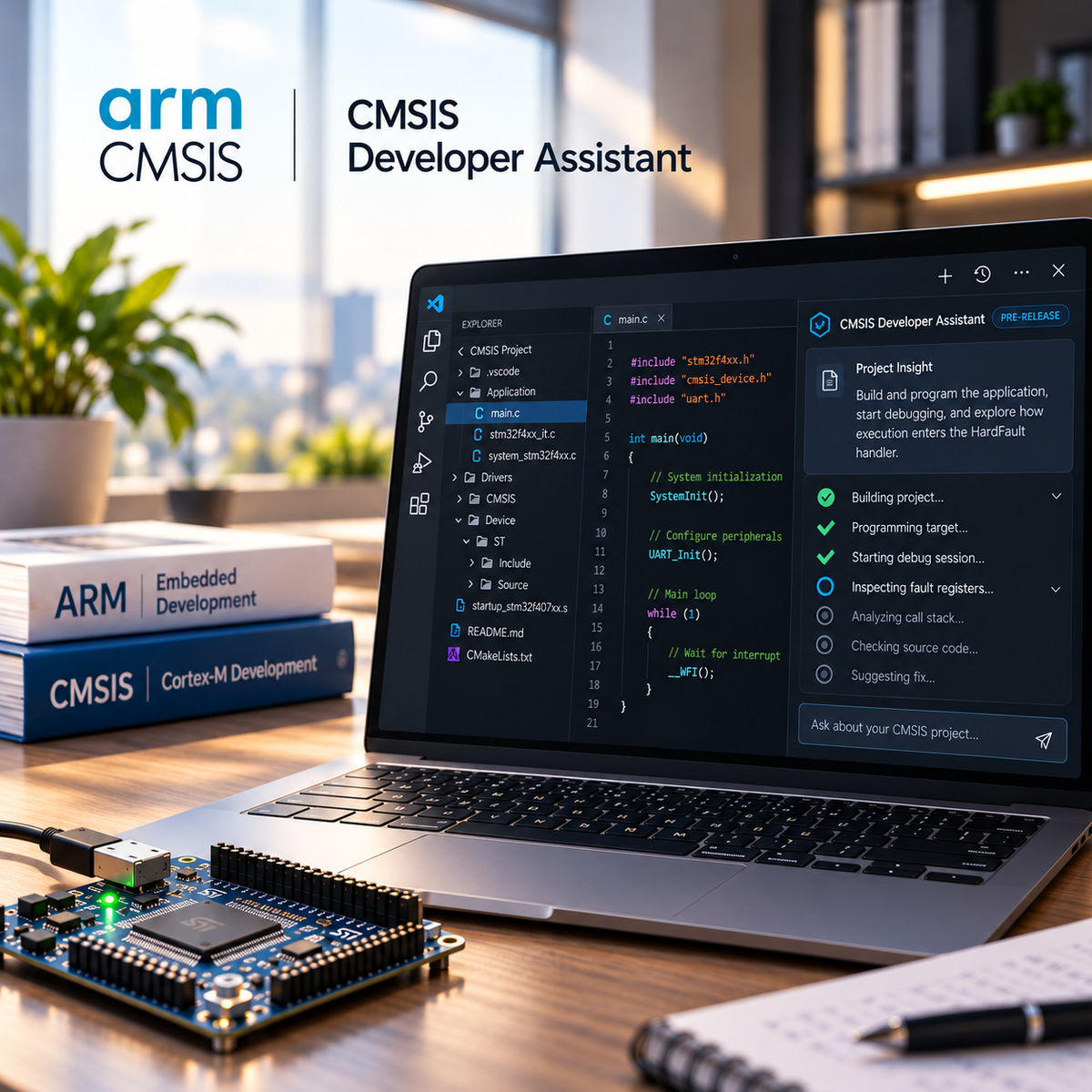
Beyond Code Generation: AI-Assisted Embedded Development with Arm CMSIS
AI coding assistants can generate a UART driver in seconds. But when the output is garbled or an application unexpectedly enters a HardFault handler, the problem may not be obvious from the sourc[...]
Read more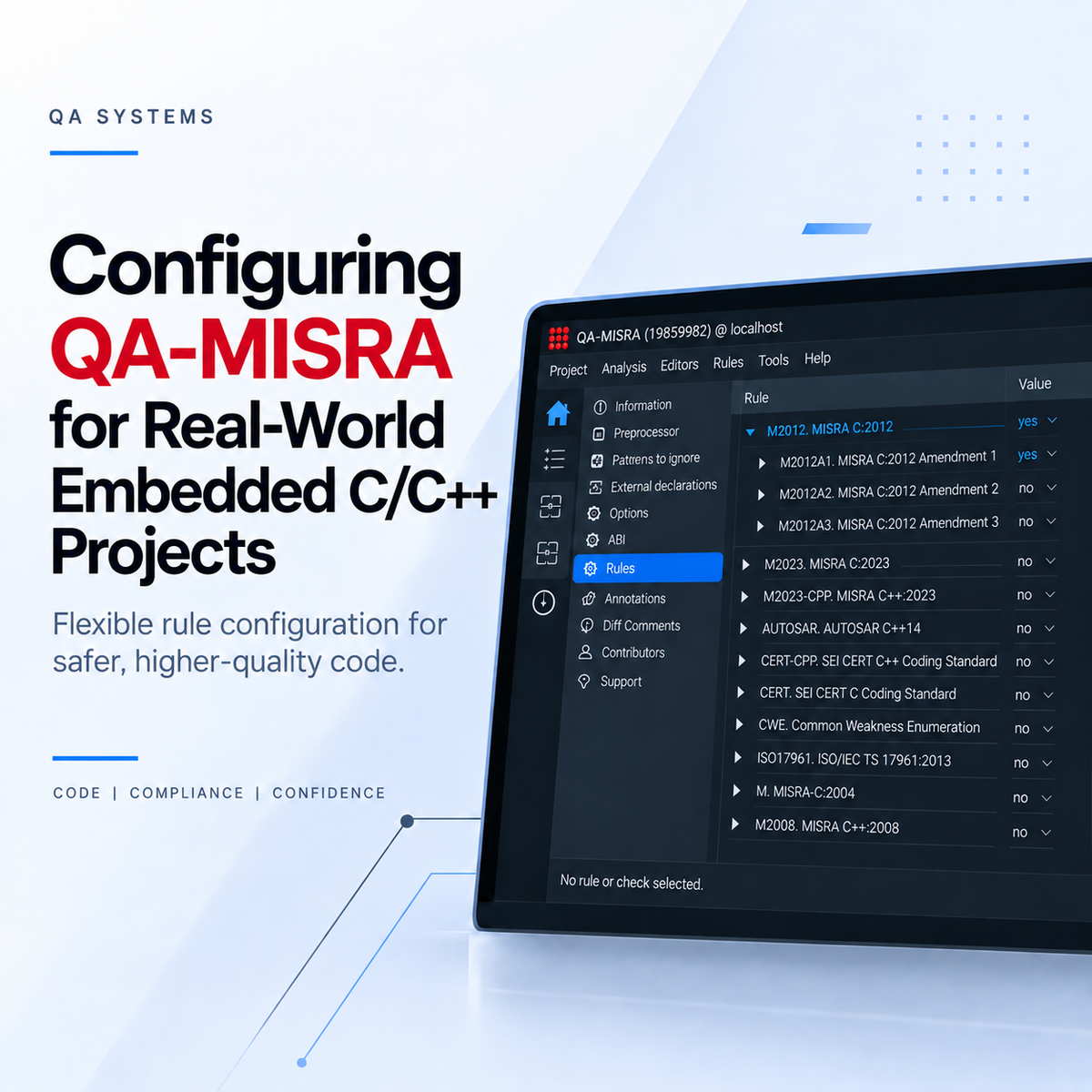
Configuring QA-MISRA for Real-World Embedded C/C++ Projects
Getting QA-MISRA running is only the first part of the setup. For an actual embedded project, you will usually need to decide which coding rules should be checked, how compiler-specific code sho[...]
Read more
EMBEDDED IS EVERYWHERE

PRODUCTS
Manufacturers
Resource center