
News

New Arm Product Updates Available
New Arm Product Updates Available The following products have been updated: Product Code Product Version ACOMP616 Arm Compiler for Embedded FuSa 6.16LTS r6p16-03rel0 This release adds download packages for Arm Certified C Library 6.16.A. It does not include any changes to the Arm Compiler for Embedded FuSa 6.16.3 toolchain, Arm Certified C++ Library 6.16LTS, or Arm Certified C Library 6.6.B download packages. Arm Compiler for Embedded FuSa 6.16.3 was released on 16 January 2026. It is a qualified release suitable for use for projects with functional safety or long-term maintenance requirements. For more information, see the Release Notes available via developer.arm.com/documentation.
Learn more
Cantata Now Available as a VS Code Extension
Hello Engineering Team, My name is Hrutik from the JORAL Engineering Team. QA Systems Cantata, a trusted solution for unit testing and code coverage, is now expanding its accessibility with a new Visual Studio Code extension. Known for helping teams automate testing, run efficient test execution, and generate clear diagnostic reports, Cantata helps development teams detect issues early and improve software quality with confidence. Just a quick note to let you know that Cantata is now available as an extension pack for Visual Studio Code. With this latest update, developers can now use Cantata directly within VS Code while still benefiting from the full functionality traditionally available in the Cantata IDE. This integration makes it easier for teams already working in VS Code to adopt Cantata without changing their workflow, improving efficiency and accessibility. To get started: Open Visual Studio Code Go to the Extensions tab Search for “Cantata” You should see a set of Cantata-related extensions—install the ones you need If you’d like to see how Cantata works within VS Code, I’ve included a short demo video for reference: 🎥 Cantata Visual Studio Code Extension Demohttps://www.youtube.com/watch?v=HClll6OWOWg&list=PL-3AenM-IauNUzUAE5SxDm1fboHdHobXr Feel free to reach out if you have any questions or would like a walkthrough. Hrutik Champaneri Field Application Engineer Email: hrutik.champaneri@joraltechnologies.com https://www.linkedin.com/in/hrutikchampaneri/ https://joraltechnologies.com/
Learn more
CompCert Qualification Achieved for Avionics Software
AbsInt is proud to announce that at the beginning of 2026 the CompCert compiler has officially been qualified for the Multi-Function Computer New Generation (MFC_NG) of ATR 42/72 aircrafts. For the first time, certification credits from compiler usage can be claimed for critical avionics software in compliance with DO-178C, DO-333, and DO-330. Successful qualification of CompCert for the Multi-Function Computer New Generation (MFC_NG) of ATR 42/72 aircrafts Claiming certification credits from a compiler allows applicants to eliminate, reduce, or automate specific objectives defined by DO-178C. The use of CompCert supports the objective of verifying property preservation between source and object code — even in the presence of compiler optimizations. As a result, test effort can be reduced. For example, formal verification performed at the source-code level can replace certain object-code testing activities otherwise required to demonstrate that the executable code complies with low-level requirements and maintains robustness. The AbsInt Qualification Support Kit further reduces certification effort and cost. It represents a major advancement in the qualification of compilers for avionics software at the highest assurance levels under DO-178C. CompCert is the first commercially available optimizing compiler to be formally verified. The machine code it generates is mathematically proven to conform exactly to the formal semantics of the source C program. CompCert supports multiple target architectures, including PowerPC, ARM, TriCore, RISC-V, and x86. In recognition of its groundbreaking formal proof, CompCert received the ACM Software System Award in 2021. It has been successfully deployed in commercial projects for many years and has also been qualified in safety-critical industry applications certified under IEC 60880. By adopting CompCert, organizations can achieve significant gains in application performance and development efficiency while reducing the risk of malfunctions due to miscompilation. If you have any questions, please do not hesitate to contact us.
Learn more
Canata 26.01 AI-Assisted Test Generation for Cantata
We hope you have had a good start to the new year! As promised, we are delighted to announce the release of Cantata 26.01, featuring the innovative AI-Assisted Test Generation and a new Visual Studio Code Extension Cantata 26.01 now available AI-Assisted Test Generation for Cantata Cantata 26.01 introduces the Cantata Test Automation Skill: a new integration that brings AI-assisted test generation into your Cantata workflow. By combining Cantata's proven testing framework with the capabilities of Claude Code (Anthropic's agentic coding tool), this skill enables developers to generate unit tests for C/C++ source code using natural language commands. Visual Studio Code Extension The new VS Code extension in Cantata 26.01 allows the creation of Cantata test scripts directly within the IDE, featuring a fresh new user interface and extensive configurability. To create a new test script, developers start by opening the test script configuration view. Within this interface, they can select the source files to be tested, define the script name, and configure other basic settings from the main configuration tab. Additional tabs provide more detailed controls, such as options for stubs and wrappers, while advanced customization is available through the extension settings for even greater control over the test script. Check out our demo videos on the new features Cantata AI-Assist Cantata VS Code Extensions Further technical details can be found here: Technical Note - Integration with Claude CodeCantata 26.01 Release Notes
Learn more
New Targets - StackAnalyzer for ARM 32-bit/LLVM/Clang-based compiler - StackAnalyzer for ARM 64-bit/LLVM/Clang-based compiler - StackAnalyzer for Infineon TriCore-AURIX/CompCert compiler - TimingProfiler by now support exactly the same targets as StackAnalyzer - TimeWeaver for Infineon TriCore-AURIX/CompCert compiler - aiT for Infineon TriCore-AURIX CPUs New QSKs - QSK for TimeWeaver for ARM 32-bit - QSK for StackAnalyzer for C28x - QSK for StackAnalyzer for MIPS
Learn more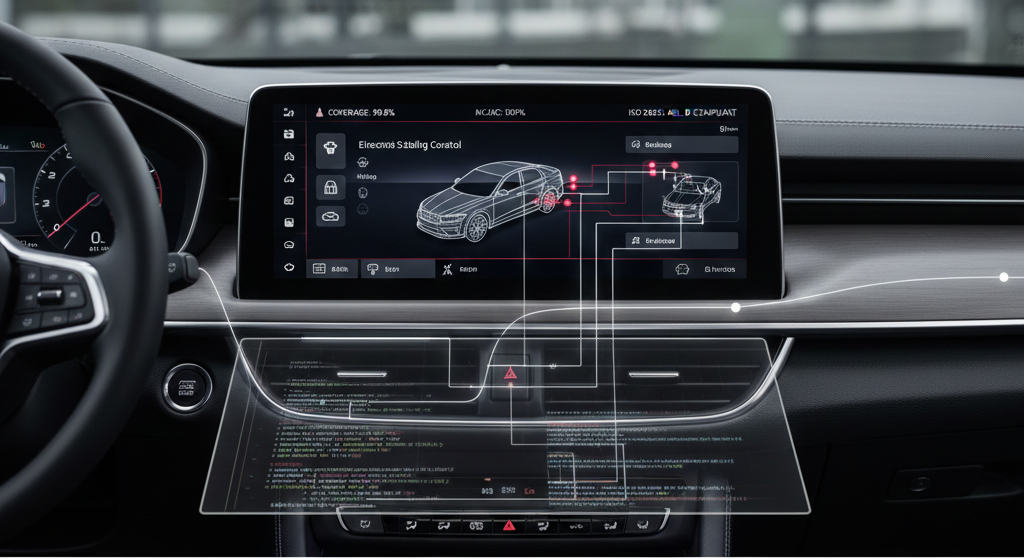
Functional Safety in Automotive: ISO 26262 Testing Best Practices
Functional safety is a non-negotiable requirement in modern automotive software development. ISO 26262 provides the regulatory framework to ensure reliability and effective risk management across vehicle electronic and electrical (E/E) systems. To meet these demands, certified tools from QA Systems, Cantata and QA-MISRA, form the backbone of robust ISO 26262 testing strategies, enabling rigorous verification, automation, and full traceability for projects targeting Automotive Safety Integrity Levels (ASIL) up to D, the highest integrity tier for critical systems such as autonomous braking and airbag deployment. ISO 26262 Testing Principles ISO 26262 defines a structured, lifecycle-driven verification process that begins with hazard classification and ASIL determination and continues through: requirements definition and bidirectional traceability unit and integration testing fault injection and robustness testing structural and code coverage analysis For example, in Level 4 Autonomous Emergency Braking (AEB) systems, the lifecycle starts with item definition and Hazard Analysis and Risk Assessment (HARA), followed by measurable safety requirements mapped directly to verification activities. This disciplined approach has been critical in preventing failures such as unintended acceleration, incidents that historically led to major recalls and industry-wide safety reforms. QA Systems: Enabling ISO 26262 Compliance Cantata SGS-TÜV independently certified for use up to ASIL D, Cantata automates: unit and integration test generation branch and MC/DC structural coverage requirements-based testing fault-injection and robustness validation Cantata directly supports the confirmation review phase of ISO 26262, where independent assessors validate the effectiveness of implemented safety measures. QA-MISRA QA-MISRA complements Cantata by providing: automated static code analysis enforcement of MISRA C/C++ coding standards tool qualification kits for compliance reporting early detection of unsafe language constructs and resource usage Together, Cantata and QA-MISRA deliver a certified workflow that supports ISO 26262 requirements across all ASIL levels. Real-World Testing Examples Emergency Braking Systems (AEB): Automotive OEMs use Cantata to simulate sensor faults, actuator failures, and unexpected vehicle maneuvers, verifying that embedded software consistently responds within defined safety limits. QA-MISRA ensures the underlying ADAS codebase complies with MISRA rules to prevent undefined behavior before deployment. Electronic Throttle Control: In one documented case, ISO 26262 verification activities uncovered shortcomings in functional safety implementation, prompting revised software architectures and significantly strengthened validation processes. ISO 26262 Testing Best Practice To build a defensible functional safety case, automotive organisations should: establish bidirectional traceability between requirements, tests, and results adopt automation for regression, fault injection, and interface testing maintain comprehensive documentation using certified tools (Cantata and QA-MISRA) to streamline independent confirmation reviews integrate simulation methodologies (MIL, SIL, HIL) to validate fault behaviour and edge cases continuously update safety plans and audits to reflect new risks, technologies, and regulatory updates By combining these best practices with QA Systems’ proven toolsets, automotive teams can confidently meet ISO 26262 requirements, safeguard public trust, and protect road users against the evolving risks of embedded vehicle systems. Mapping QA Systems Tools to Unit, Integration, and System Testing QA Systems tools align precisely with the classic software testing pyramid: unit, integration, and system testing. Unit Testing Cantata is purpose-built for automated unit testing of embedded C and C++ software. It enables verification of individual functions or modules in isolation using: white-box testing techniques branch and MC/DC code coverage full requirements traceability Key capabilities include automatic test case generation, stubbing, and mocking, ensuring dependencies are controlled and each test focuses strictly on the logic under test, fully aligned with ISO 26262 expectations. Integration Testing Cantata extends seamlessly into integration testing by allowing multiple modules, subsystems, and APIs to be verified together. It supports: call interception and wrapping controlled fault injection interaction and interface validation This ensures that not only do individual components behave correctly in isolation, but that data flows, error handling, and interfaces remain robust, as required for ISO 26262 item integration. System Testing While Cantata focuses primarily on unit and integration levels, its outputs form the foundation of system-level qualification evidence. For full system validation: Cantata provides low-level dynamic test and coverage evidence QA-MISRA supplies coding-standard compliance evidence Both tools contribute traceable, auditable artefacts required for final system certification Together, they ensure that system-level safety is built on verified, standards-compliant software from the earliest phases of development. Summary Table Test Level Main QA-Systems Tool Capability Highlight Unit Testing Cantata Isolate modules, auto-generate tests, and coverage analysis Integration Testing Cantata Combine modules, wrap/call intercept, interface testing System Testing Cantata & QA-MISRA Evidence & compliance for system qualification Together, Cantata and QA-MISRA provide end-to-end ISO 26262 verification, from precise code-level correctness to system-level safety assurance with certification-ready evidence. © 2025 QA Systems. Published by JORAL Technologies.
Learn more
New Arm Product Updates Available
Dear customer, The following products have been updated: Product Code Product Version DEVST-GLDF Development Studio UBL Gold FUSA r25p1-00rel0 This release of Arm Development Studio includes the next-generation Arm Toolchain for Embedded Professional (ATfEP) in addition to Arm Compiler for Embedded 6 (AC6). Please be aware that consequently Development Studio installation time has significantly increased on Windows. For convenience of Windows users, we provide two installation packages, one that incudes ATfEP and one that does not include ATfEP. We are working to reduce the Windows installation time in future releases. Did you know you can simulate and configure IP in Arm IP Explorer? Get started today.
Learn more
DO-278A and the Importance of a Qualifiable Toolchain for Aerospace Software
Developing safety-critical C and C++ software for air traffic management or aerospace systems under DO-278A demands the highest level of reliability and verification rigour.A qualifiable toolchain for aerospace software, combining static analysis, dynamic unit testing, and code coverage, is essential to meet the standard’s requirements for traceability, compliance, and software assurance. Why a Qualifiable Toolchain for Aerospace Software is Essential Early Defect Detection & Compliance: Static analysis tools identify vulnerabilities and standard violations (such as buffer overflows, insecure libraries, and directive violations) early, before code execution, preventing defects from propagating. This proactive approach supports DO-278A’s emphasis on defect prevention and standard conformance. Dynamic Testing & Coverage Evidence: Dynamic unit and integration testing, together with structural coverage (statement, branch, and MC/DC), proves that requirements are correctly implemented. These metrics are essential for high-assurance levels (AL1/AL2), ensuring no hidden errors remain in safety-critical code. Traceability & Bidirectional Verification: DO-278A requires complete traceability from requirements through implementation and testing. A qualified toolchain for aerospace software ensures every test, requirement, and code path is linked maintaining audit-ready traceability when changes occur. Tool Qualification for Reliability: If a tool’s output influences further development or verification without manual review, tool qualification guarantees reliability. As with DO-178C, qualification ensures that tools do not introduce verification errors, preserving software integrity and certification readiness. Benefits and Regulatory Rationale Increased confidence in software integrity by automating error detection, remediation, and traceability. Empirical and structural coverage data, as demanded by high-assurance AL1/AL2 software components. Minimization of manual error and fulfilling regulatory requirements for tool usage in safety-critical development, crucial for approval and certification in aerospace and air traffic management domains. Together, these practices ensure safe, reliable, and certifiable C/C++ software that meets DO-278A’s strict verification and traceability standards. How to Meet These Challenges Cantata and QA-MISRA from qa-systems.com form an expertly certified and integrated toolset for developing, testing, and qualifying safety-critical C and C++ software compliant with the DO-278A standard. This toolset is uniquely suited to accelerate safety standards compliance through automated static and dynamic analysis, comprehensive coverage metrics, and test automation capabilities critical to aerospace software development. Why Cantata and QA-MISRA Are Ideal for DO-278A Cantata Automates unit and integration testing for C/C++ Supports dynamic execution on both host and embedded targets Provides code coverage analysis, regression testing, and requirements traceability TÜV-certified for the highest integrity levels, meeting DO-278A verification needs QA-MISRA Performs static source code analysis with 900+ compliance checks Enforces MISRA C/C++ and other safety-related coding standards Ensures zero false negatives for precise, early defect detection Complements Cantata by improving code quality before runtime testing Together, Cantata and QA-MISRA deliver end-to-end coverage of DO-278A verification needs, from static compliance to dynamic validation, backed by certification kits and qualification documentation for efficient regulatory approval. Applications in Aerospace and Air Traffic Management The combined Cantata and QA-MISRA toolset is ideally suited for Avionics Flight Control Systems: Software controlling aircraft flight surfaces and stability, requiring rigorous unit and integration testing to avoid runtime failures. Air Traffic Management Systems: Safety-critical control and communication software ensuring safe airspace operation with strict code quality and traceability demands. On-board Diagnostics and Safety Monitoring: Embedded software performing real-time monitoring and fault detection with a need for exhaustive compliance with coding standards. Mission-Critical Navigation Systems: Systems that demand flawless operation due to navigation safety requirements, verified through automated unit tests and static checks. Satellite Command and Control Software: Software in satellites controlling functions under extreme conditions, validated using these tools to ensure robust, error-free operation. Conclusion DO-278A compliance relies on a qualifiable toolchain for aerospace software that integrates static and dynamic verification, structural coverage, and full traceability. Cantata and QA-MISRA deliver this capability in one certified, automated environment, enabling early defect detection, comprehensive testing, and assured qualification. Together, they provide aerospace developers with a faster, more reliable path to compliance with safety-critical software standards. For more information about QA-MISRA and Cantata, visit qa-systems.com. © 2025 QA Systems. Published by JORAL Technologies.
Learn more
Release 25.10 of AbsInt Tools for Safety-Critical Software Development
All Products =============== - The AbsInt Linux tools require now RHEL 9 or compatible and ship a Dockerfile creating a compatible Rocky Linux 9 container to facilitate deployment in containerized environments. aiT, TimingProfiler, StackAnalyzer, TimeWeaver ================================================== - NEW: aiT for TI TMS320F28386D/4D/8D - NEW: aiT for ATSAME51J18/19/20A - NEW: aiT for TMS570LC4357 rev B - Improved Project/Workspace Diff-Viewer, Sections View, and Symbols View - Enhanced analysis setup capabilities enable users to create new analysis projects more efficiently Astrée, RuleChecker ====================== - NEW: Delta analysis displays summary of differences between project revisions by tables and charts, and classifies alarms as new/old. - NEW: Astrée supports sound analysis of bounded recursions - Enhanced safety manual by DO-356A and ISO 21434 verification goal coverage - Enhanced VS-Code plugin (LSP server) by "single translation unit" mode, enabling faster rule checking - Improved rule coverage of CERT C/C++ and CWE CompCert ============ - NEW: CompCert for TriCore (1.6.x) - Improved optimizations for arithmetic runtime library functions - Generation of position-independent executables (PIE) and position-independent code (PIC) for AArch64, RISC-V and x86-64 Plugins ========= - AbsInt toolbox for TargetLink supports "diff" mode as default alarm comment mode. A complete list of all new features and improvements can be found here. You may watch a demonstration of selected new features on the AbsInt YouTube Channel.
Learn more
PRODUCTS
Manufacturers
Resource center